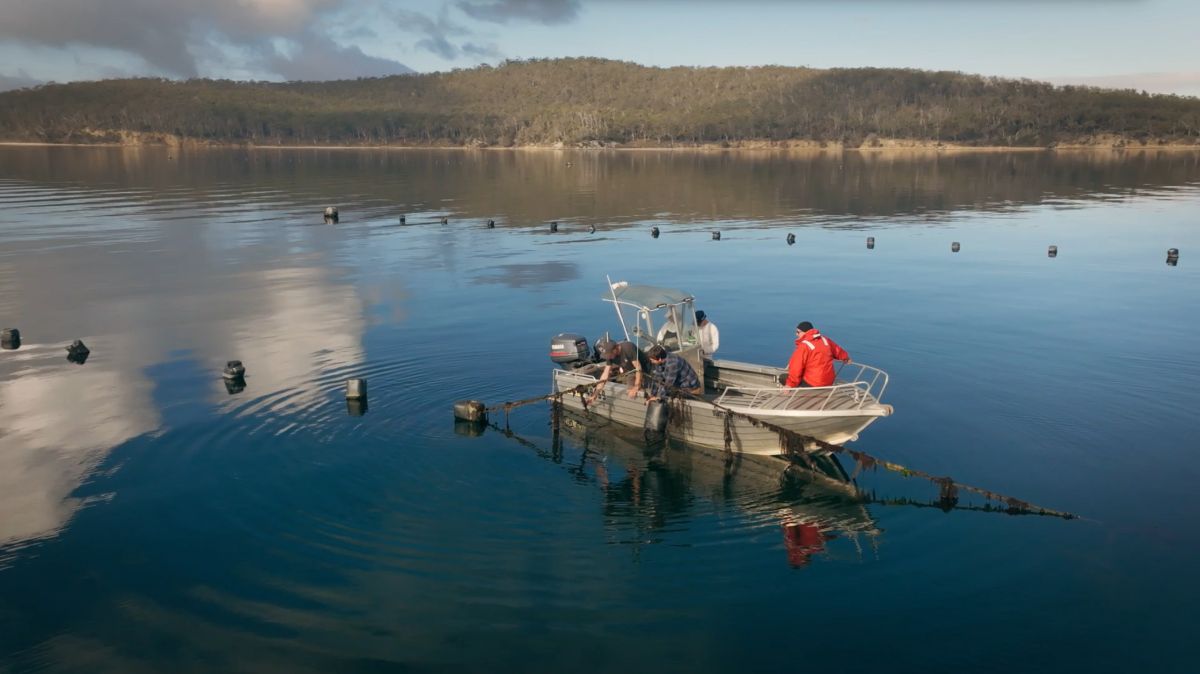
Bruny Island Seafarm began with a simple conviction: that a coastal community can build a new source of sustainable employment from the waters around it. Jobs have always been a challenge on Bruny, where hospitality and tourism carry most of the load. We set out to create something different — a regenerative seafarming industry in the D'Entrecasteaux Channel, with the potential to become a major employer across Tasmania and, in time, coastal communities right around Australia.
We are a community-based social enterprise, structured as a non-profit foundation working alongside a Pty Ltd operating company — a model that lets us pursue both community benefit and a commercially viable business. Our approach is integrated multi-trophic aquaculture (IMTA): regenerative seafarming that grows several species together in a single system, so that one species' outputs become another's inputs. The result is seafood produced in a way that helps restore the water it grows in, rather than depleting it.
We have moved well beyond the idea stage. Our first pilot farm is already in the water, with a second to follow within months — proving viability, looking at the practical challenges, and laying the groundwork for a larger operation. We are fortunate to be able to draw on the considerable aquaculture experience already held by locals on Bruny and the Channel area. The offers of practical support without asking for any compensation has been very heart-warming and shows the depth of community support behind what we are doing. This early progress has been recognised beyond the island, most recently through our selection into the Hatch: Taronga Accelerator Program. This program provides us with mentorship, networks and potential investment to help turn the concept into a long-term, viable enterprise.
Our long-term vision is a network of regenerative seafarms — beginning on Bruny, expanding across Tasmania, and ultimately reaching coastal communities around Australia. Rather than working against the ocean, we work with Mother Nature: these farms produce not only seafood, but environmental benefits — carbon drawdown, nutrient cycling, and habitat — alongside meaningful local jobs. It's an approach built on a simple idea — sustaining the seas that sustain us. Perhaps most telling is the support we've received: it has come from across the political spectrum and from every segment of the community, including people who rarely find themselves on the same side of marine and environmental questions. In a conversation that so often divides, regenerative seafarming is something Tasmanians have been able to get behind together.
For more information, visit www.greenwave.org and www.greenwave.org/hub, whose model acts as a guide for what we plan to achieve here in Australia. For direct contact, email us at
Expressions of Interest or Support
Please get in touch with us if you'd like to express support, want to get involved or would like more information.
Use the form below to make contact and we will get back to you shortly.